Friday, 30 November 2018

Open World Fatigue and the Resurgence of Tabletop RPGs


By this point in time, everyone in this solar system has been exposed (either directly or indirectly) to the hype surrounding Red Dead Redemption 2 – a console game which offers players the highly immersive opportunity to traverse an open-world, R-rated, Wild West as a slack-jawed gunslinger. The detail is immaculate.

The release of RDR2 comes less than a month after the latest installment in the Assassin’s Creed series: Odyssey, took players on a massive - and I mean just obnoxiously massive - romp through Ancient Greece during the height of the Peloponnesian Age. Now what do the above two titles (along with other honourable mentions God of War, Breath of the Wild, Far Cry, and Elder Scrolls) have in common? An Open World, and it seems enthusiasts keenly immersed in the rich fantasy worlds encompassing many Top-tier video game franchises have grown weary of the trend now dominating a certain genre…


Massively open-world games have surged in popularity since the days of GTA 3 introduced a new type of experience – comprised largely of exploring a huge map, completing numerous side objectives and quests, and collecting various articles of shit no matter how gratuitous. The theme of collecting trinkets in sprawling 3D realms predates even Liberty City, harkening back to the golden era of colourful platform titles such as Banjo-Kazooie on the legendary N64. Yet, as so often happens in the evolution of products or cannon, subsequent entries in a series tend to be unduly pressurized into outperforming their predecessors in order to net a bigger returns for their overlord investors. In newspeak: Open world games just keep getting bigger and bigger.

Simply put, bigger isn’t always better, and it's the fans who ultimately pay the price: Not just shelling out 80 plus dollars for that hot new release; but afterwards being left with an obnoxiously large map to navigate- and in the case of Odyssey- a million repetitive and sometimes uninspiring tasks to perform parallel to the main storyline. Performing these tasks is largely what gains you the xp necessary to actually be able to level up and complete the game.

Though RDR2 at least gives players the opportunity to fast track through its incredible story missions sans gorging on the vast remainder of the world’s offerings in order to further progress, the sheer volume of story missions themselves can even become daunting towards the end of the game when the main character’s arc has more or less wrapped -and when the initial allure of exploring the inventively realistic -yet somewhat gratuitous- activities of the Old West has lost its appeal. And yes, this is despite the incredible attention to detail and immersion which has brought this so-called cowboy game to life.

Apparently a lot of glitches in the Wild West too.
It would seem open-world game designers are now operating under a new-age assumption: That the vast majority of players can afford both the time and patience required to achieve that coveted 100% completion, and the trophies it so yields. They have, in turn, engineered massive experiences to top all previous efforts with the expectation that their loyal subjects will commit upwards of 100 hours or more into the venture.

Now for those who truly have the time and desire to lose themselves in these gargantuan gaming experiences, we are living in a truly glorious age. But when examining statistics stating that only around 10-20 % percent of players actually even completed the first RDR’s story- despite the game’s massive success and popularity -yields a deeper questioning of the real motivations of adventure-seeking gamers.  This now-frequent trend of bigger worlds with a greater number of quests has left many with a creeping sense of fatigue when faced with the monstrous task of fully completing these next-gen open world adventures. Gone are the days of quick and efficient storylines that still provided a sweeping sense of epic scale.

And yet, contrary to the current state of affairs, a resurgence of sorts has been unfolding in our midst: Exhausted imagineers are now looking to different mediums to fuel their desires for exploration and adventure. With the somewhat-recent release of D&D5e, more players than ever before are finding their way to the tables of lore, to feast on stories which may or may not grant them far more control over their destinies and fates. We examined this resurgence in greater detail with the goal of theorizing a few reasons why more gamers are sitting down at the table with dice in their hands instead of controllers. Lets take a closer look at some of the benefits offered by the essentially non-linear gaming of tabletop RPGS:


Efficiency

On the theme of saving time and maximizing efficiency: Fast travel seems the most obvious point to start with here. A lot of what contributed to RDR2’s lengthy completion time was the need to physically ride cross country for most of the missions -with only a limited fast travel option available to be unlocked. Odyssey definitely did fast travel better, however with the sheer volume of islands to explore and irrelevant characters to interact with, the need to cover a lot of ground is always present in the game. Enter the magic of RPG: Where players can quickly cover a hundred and sixty-eight million billion miles of travel(Temporal prime or not) all through the clever storytelling of their beloved Game Master. (GM)  Oh you don't want to take 3 movies to get the ring to Mordor? BAM you're there, it was a really rough journey, you gained no xp, have fun you Gondorian bastard.

So yes, the journey is more important than the destination, and it's always advisable to fight your way through enough pain to gain adequate xp before ascending that dirty wizard's tower, but just know that the power of spoken word elicits many shortcuts for story-driven enthusiasts to get right down to business - and to not have to literally sail/battle their way across the ENTIRE Ancient Greek world in search of resources to upgrade their ship so they can even attempt that final naval battle in the story to get to the next on-land mission which is what they actually want to play. Confused? Me too.

 Autonomy

When it comes to progressing further in an epic game's story, there's simply no better feeling than having to do tasks you could not give less of a shit about, yet exist only as gratuitous filler needing to time-vampire your attention for sustenance. Not. One of the very best aspects of Tabletop RPGs is how it's the players who choose which tasks have meaning -and which ones don’t - relative to the overall direction the party has agreed to venture in. This aspect seems a stark contrast to the open-world dictates of console games -which prod players into sometimes unnecessary encounters. (Think collecting ingredients a for a one-off Ancient Greek Granny so she might yet revive her weathered husband's limp doodle- kind of arbitrary and then try to contain your own excitement.)

The most profound of GMs take the time to really listen to what their players are looking for in their RPG experiences, and then proceed to offer a highly customized adventure that just smashes those KPIs right out of the dungeon. Interesting to note however, is how Odyssey has incorporated greater RPG elements into it's gameplay to perhaps supplement this perceived lack of choice -Namely the addition of different responses available in every interaction that can lead it towards a differing outcome. This is a promising development to be sure, yet if the interaction is boring and pointless to begin with, the only thing we’re gonna be choosing is how to gtfo.


Probability

Perhaps the most prominent difference between console and tabletop adventuring lies in the shadows of chance and fate. With massive games like Odyssey and RDR2, players eventually and oftentimes find themselves repeating the same scenarios over and over again as they near the end of the main story. While progression in a game almost always grants promises of upgraded gear and abilities to just decimate with, there are only so many times you can infiltrate and wreck a fort -or find yourself laser- dropping outlaw after outlaw yet again in the desert- before you start to just drift through the motions for the sake of completion. To be fair, the closed ecosystem of open-world console games are, by their very nature, linear. But to those looking to broaden their horizons and refine their immersion, a seat at the table doth beckons...

Among the most poignant selling points of tabletop RPGs is that no matter how powerful a player or creature becomes, they are always at the mercy of the dice which they roll. If you’re unlucky, fate can be more of a curse than a gift, but what’s certain is that this whimsical style of adventuring demands a much higher caliber of creative problem solving from players if they are to skillfully navigate the unlimited variations of encounters a GM can throw their way. For this reason, subsequent games of D & D are rarely the same despite a GMs overarching narrative structure. Too much is left to chance. At the end of the day, this may very well be preferable to spending two hours straight casting bound sword at a Horker to fast track your Conjuration level right into that Dremora Lord’s tender and loving arms. Just try to let them down easy…


It truly is incredible the level of sophistication, scale, and innovation present in recent open-world console releases. The insights pondered here today are in no way a manifesto condemning this genre of video game, as I for one thoroughly enjoyed both Assassins Creed Odyssey and Red Dead Redemption 2 for what they were: Epic cinematic stories with some epic game play moments. It’s when one starts to unravel the technicalities of progressing through those stories to actually see them unfold however, that the daunting reality of this fatigue begins to hit home.

The solution may be as simple as game designers catering to all parties by releasing future open-world games with both fast-tracked and extended story campaigns available to play based on gamer-preference. It may not. In fact, you may very well be asking why the hell, since studios are bound to collect unfathomable amounts of our dollars for new releases regardless, they should even care at all about relinquishing back to us a few hours of invested time? Well bud that's a very fair question. But in a shifting world placing more and more emphasis on soft skills like empathy, team building, and face to face social acuity -and through a gaming experience offering players countless opportunities to continually enrich these skills -the resurgence of tabletop RPGs may just end up disrupting a greater number of traditional video gamers than many open-world studios would be comfortable admitting.

To foster greater perspective, I leave you this final analogy: Would you rather wield the power of a god but be confined to a village, or face the cosmos as a child, with endless possibilities for growth and expansion, and eternity at your fingertips. They say it's the journey not the destination but the choice will always be yours.


Written by: Jeff Clive.

Wednesday, 28 November 2018

Battlefleet Gothic: Relictor Space Marine Sword Class Frigates


So you may be asking yourself "Andrew, why did you include two Sword Class Frigates in your Relictors fleet? It seems like an arbitrary choice."

And frankly you would be right. Essentially I need to make up for some points and these two frigates fit the bill. So is their inclusion a tactical choice? Nope, purely just to make up the points.


And this is not the first time I have used Sword Class Frigates for this very purpose. Even in my small Space Wolf fleet I have a couple of these to help make up the points.

Unlike my Space Wolf frigates however these two are not real Games Workshop models. Like the other Relictor Ships before them they are 3D printed, though admittedly from Shapeways rather than home-made.


Thankfully any escort class vessel can be grouped in a squadron together of 2-6 ships so these two ships can operate on their own or in a larger group of escorts.

So we will see what Ivan (our Relictor's Player) decides when he throws down the fleet.


And the Relictor's Space Marine Fleet is well on the way to being finished. Next I have to finish up a group of seven Hunter Class Destroyers and then I can finally teach some new players how to play Battleflet Gothic! It has been too long. But soon... Soon. 


Written by: Andrew Gregory

Monday, 26 November 2018

JADE has T-shirts!


JADE has been talking about making T-Shirts for some time now. But we never really got it together. Well now I am pleased to say that JADE hasT-Shirts!

What is your favourite class? Now you can show them off to your friends in a new JADE Character Class T-Shirt!

Available on our store.

But before you go running off to get the classiest T-shirt out there, here is what you need to know about JADE's shirts.


The Shirts are from Printify

The production and shipping of the shirts are handled through Printify. That means that you will need to pay shipping on the shirt separately from any dice you order.

However the good news is that Printify is based in the United States! So our American customers will have cheap shipping rates and short turn over times on their orders.

They Come in all Standard Sizes

From XS-3XL JADE T-shirts come in all sizes and currently only in black with white ink. We might do other colours in the future. Let us know what you would like to see!

They Have Every Class

You can get a shirt of every standard class in the DM's Guide, and a special shirt for the DM in your life.

So get your shirt now and start showing off both your class and style!


Written by: Andrew Gregory

Friday, 23 November 2018

JADE's Black Friday Sale!


That's right! For Black Friday and through to Cyber Monday using the code WAFFLES2018 to get 20% off your entire order!

This code is usable for everything in store and last until midnight Monday the 27th! So get your dice from our store and get those character's rolling!

And at JADE we always love to hear from you guys! So let us know about the first character you roll up!


-Andrew
JADE Gaming

Wednesday, 21 November 2018

Battlefleet Gothic: Relictor Space Marine Gladius Class Frigates


Moving along through the rest of my Space Marine Relictor's fleet are these four Gladius Class Frigates, that I found on Thingiverse.

These models are much large than the standard  Games Workship Gladius model and the designer said that he intended them to look like miniatures Strike Cruisers, and with that in mind I think he did a great job.

Now I will admit they are a little large for your average frigate, but in the world of Battlefleet Gothic that doesn't really mean much as ships (even within the same class) come in all shapes and sizes.


Now as a Escort vessel Gladius Frigates aren't really anything special. However in my proposed squadron of 4, they will have a combine Weapons Battery strength of 16 and that is nothing to shake a stick at!

That combined with their top speed of 30cm should make them a deadly and mobile unit.


Despite having battle the Space Marines in BFG before I have actually never fought against a group of Space Marine faction escorts. Sure I have fought Sword Class Frigates in Space Marine fleets, but never the actual Space Marine specific ships.

So I am interested to see how they preform and if they are worth the extra points.


And here is the my Space Marine Relictor fleet so far! Next on the docket I have 7 Hunter destroyers and 2 more Sword Class Frigates and then this fleet is done and we are ready to fight!


Written by: Andrew Gregory

Tuesday, 20 November 2018

Secret Teams: A Ridiculous Tabletop Game Scenario


Before playing an absolutely massive 7000 total point game of Warhammer on a gigantic 8x4 foot table, I was chatting with my old friend Tom about the upcoming game. I told him we were going to play on teams (2v2) and that we intended to randomly determine.

We thought this would keep things fun and fresh, and it did! Despite the fact that I lost the game it was a great battle!


So while describing the up coming game and forces (Death Guard, Eldar, Relictors, Tyranids) Tom and I we started joking around with different team games we came up with the hilarious scenario that we call "Secret Teams ".


While we talked about this in context of Warhammer 40k, this could really work with any tabletop miniatures game, and works as follows.

Teams are chosen in secret from all players, and who's team you are on is not revealed until the end of the game. Players must guess what team they are on, although they are allowed to engage any other force on the table.

For each victory Point scored record who scored it and against which side it was scored. At the end of the game the teams are revealed and any victory points scored against your teammates are not part of your victory point total.

The teams then total their legal victory points and the side with the most VP's wins. Obviously a huge part of this scenario is the mind games and table talk as you try to convince the other players that you are definitely on their team and thus you shouldn't be shooting them.


 Will it be an incredible match that changes the way to you play Tabletop Games forever!? Probably not no. But will it be a hilarious way to shake things up around your game group for a session or two! Absolutely!

Now we have not tried this scenario, and admittedly I could not convince the guys to give it ago, but it is only a matter of time.


Written by: Andrew Gregory

Friday, 16 November 2018

The King Kong Canvas Eagles Scenario Part I: The Concept


While sharing some of our recent Jets for Check Your 6! Jet Age on Instagram we were asked an interesting question.

After discussing how the Check Your 6! and its predecessor Canvas Eagles worked as a game, @doowopapocalypse asked:


I laughed! With both Check your 6! and Canvas Eagles firmly routed in the historical wargame category I doubted the creators ever conceived of including monsters like Godzilla or King Kong.

But with the seed planted, the idea began to grow.

Why not have giant monster rules? We would ahve to make them ourselves, but JADE has been playing Hex and Counter Air Combat games for the past seven years, I have made my own manoeuvre schedules for planes not provided in Canvas Eagles, and I have even created a small campaign - that I will share on here once I get around to testing it. How hard could it be to make a monster scenario?


Since JADE is more familiar with Canvas Eagles than Check Your 6! We decided that it would be best to start with a Canvas Eagles Scenario. And is there a more iconic Biplane Monster Battle then King Kong on top the Empire State? I don't think so... Or really know of any other giant monster vs Biplane battle...

But of course being set in 1933, not the first world war like Canvas Eagles is, it will take a bit of work to get this going. So let's go.


The Aircraft

So the first step in creating any King Kong scenario is to figure out exactly what planes were launched to take him out. This was pretty difficult, however as far as I can tell from cruising the forums the most likely plane used was the Curtiss Falcon.

Now there is some debate about whether or not this is the actual plane or if it was a Consolidated NY however in my mind, the Falcon is a better fit. The NY was a trainer and just doesn't look the part where as the falcon was a armed observation aircraft.

Since the Curtiss Flacon wasn't introduced until 1925, that places it well after Canvas Eagles scope; in which the latest plane included is the Neiuport-Delage NID 29 from 1919. So I am going to have to create a custom aircraft sheet to use the Falcon in game.

This requires comparing similar aircraft from the first world war, the top speed of the aircraft, notes on the planes effectiveness and maneuverability, etc. etc. And that is on top of actually making the sheet. It is an involved process, and I promise to include an update with my methodology and the stats of the Curtiss Falcon itself.


The King

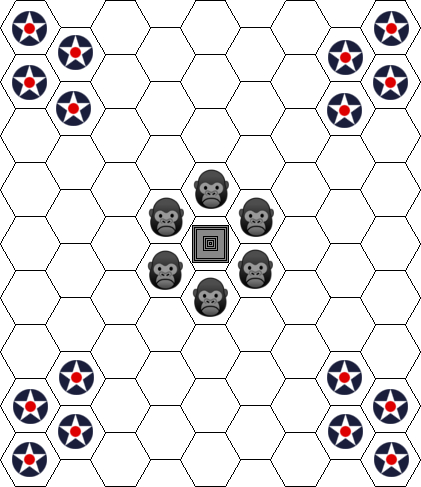
Deciding on how exactly we were going to represent Kong was a matter of some debated. The idea was that there would be a model of the Empire State Building in a central hex and then a Model of a gorilla (likely toy) would move around the out side. This would have worked fine, however it certainly would have been a little lack-luster on the table.

And so doing some more digging, I eventually stumbled across this model on Thingiverse. The diea is that the top of the empire state goes in the central Hex as planed, and then rotated to move Kong (clinging to outside) into the six surrounding Hexes.

This will still need some working out and testing, but right now this is the clear winner for our Kong Model.


The Scenario

Currently the scenario that we are calling "The Eight Wonder of the World" is very much in the planning stages with only the most preliminary work having been done. But here is what we have so far:

Between 2-16 players all flying Curtiss Falcons confront King Kong atop the Empire State building. The Falcons set up in one of the American Roundel Spaces, and Kong in one of the gorilla spaces.

Since Kong is holding Ann Darrow you can't risk hitting her and can only engage Kong at Range 1, rather than the usual range of three hexes. However Kong can strike at any one plane that is within one hex of him for massive damage!

Kong lasts for the full 32 rounds, or until the last player disengages and then each player or team totals the number of Red Hits scored.

And... that is as far as we got.

We still need to work out damage and health rules for Kong, and also factor in that engaging a giant monster is no walk in the park for even an experienced pilot.

So more updates to come as we work out and hopefully test this scenario out.

Remember that you can get the rules, and aircraft sheets for Canvas Eagles for From from their Website.

Thanks @doowopapocalypse we will do our best to get this scenario up in the air for you!


Written by: Andrew Gregory

Wednesday, 14 November 2018

Battlefleet Gothic: Relictor Space Marine Strike Cruiser


With my 850pt Plague Fleet completed my next fleet for Battlefleet Gothic is my Space marine Relictors fleet, which feature in our Curse of the Relictor's Campaign.

So like any proper space marine fleet, the first ships that I painted were these two Strike Cruisers: The default ship used by Space Marine captains around the galaxy.


Now, I have quite a bit of experience battling against Space Fleets in Battlefleet Gothic. What with my younger sister Sarah playing Space Wolves and me having prepared a small fleet for her to command including two Strike Cruisers.

Despite be calssified as Light Cruiser, Stirke Cruisers are well armed and armoured, and in my experience are a pain in the ass to take down. I have lost many a'ship to these things.


These models were part of the 3D printed ships that I received a few months back, and you can find their designs on on thingiverse to print for yourself! The are highly detailed and a fantastic match for the real ships!


And so the first of my Relictor's ships are ready to go! up next are a series of Frigates and Destroyers that should flesh out the fleet and make for an interesting fight!


Written by: Andrew Gregory

Tuesday, 13 November 2018

Andrew's 5 Ways to Help Manage Your D&D Campaign


Getting your first D&D game in with your group is fun, exciting but also a lot of work. And there is nothing more satisfying then when your palyers make it to the end of your game, completing most of what you had prepared for them. However despite how hard it is to get started, your work has only just begun.

Undoubtedly your players have changed or adding things to your game that you did not and could not anticipate, and now before you sit down and brainstorm your next session you need to figure out what happened last game what has changed going forward.

For me this means that the day after the session I have a bunch of paper work to do. But thankfully I have  a check list of these 5 things I do to help managed my on going campaigns.


1. Write up a Recap

As I mentioned in our 3 Ways to Recap Your last D&D Game article, my preferred way to handle a games recap is by writing out a short list of events from the last game.

This way all I have to to do is read through list to remember what happened last session. I also find that this helps me remember some of the subtext created by the characters. All in all however you do it figuring out a recap is a great first step into making the next game.

You can pull on the events and emotions from last game and write the outcomes and follows into your next session. 

Source

2. Calculate Player XP

I personally do not like suing milestone leveling in my RPGs. I don't think that milestones encourage or reward players for their roleplay or interesting actions in game. That being said I understand why and Game Master is hesitant to award XP: It can be a lot of work to sit down and calculate out each player's total.

So to make your life setup up a spreadsheet for each player. In it,  record the game session, the events that each player was given XP for, and the reward. Then let the spreadsheet do the math for you. I stopped having my players add up their own XP years ago when I realized that everyone's total bared little resemblance to what their XP should have actually been. So these days I just give them a solid total as to what their XP will currently be.

Aside from better rewarding players for their roleplay, XP can also give you as the Game Master an indicator of how your players are doing. Players who aren't getting as much XP as others need some focus in your next game to bring them up to snuff. Whether that is a side quest or simply a main event that you think will appeal to this palyer those not earning as much XP from other's certainly need some attention. 

On the other side, those getting more XP can usually be identified as the campaign's main driving force, and so tailoring your campaign events to suit their tastes as a player/character will often ensure that the party follows your main quest without incident.
I use an old Roman calendar I found to keep things interesting

3. Keep a Calendar

Now this isn't important in ever game, but since many of my campaigns now feature the possibility of Time Travel having a Calendar is key, and really the only way i can keep in my head what happened on specific dates.

More than aiding with Time travel, a Calendar will put your game into perspective. Events that to the players may have happened month ago in the real world, may have only happened a week ago in game. A good example of this is an event known around the JADE table as the "Penkurth Massacre" from our Arachnophobia Campaign. The event saw the party lose a player character, 2 NPCs, thousands of gold pieces worth of magic items and saw another 2 NPC taken captive. 

It was an absolute tragedy for the party. However due to scheduling conflicts in the real world the next couple of games of Arachnophobia were staggered over a few months, and the impact of that event on the aprty was largely forgotten. Luckily I had it recorded in my Calendar, and was able to reference it, and how long ago ithad happened. So despite not being fresh in my player's minds, I was able to remind them that in game it had only happened a week ago, and to act accordingly.

A small sliver of the my Arachnophobia World Map

4. Trace the Party's Journey on a Map

I have no less than four campaigns running in my Arachnophobia World. So keeping everyone's locations straight can be a bit of a challenge. So to help this I have a large map that I created in a program called Dia. On this map I track the different party's journey's using different colour lines.

This way I can know where they have been, where they might go, and of course, most importantly if any two parties are destined to cross each other's paths.

Having a map gives me the big picture of my world, and tracking my parties through it gives me a sense of how much ground they have traveled.

The Game plan for my Age of Heroes Campaign. Also made using Dia.

5. Consider the Possibilities

Now that you have your recap, your player's XP, your calendar, and your map, you should ahve a great idea of where you are and what is happening in your campaign. The final step to managing your game is to start writing the next session. But before you start throwing down those prose, you will need to take some time to consider the possibilities.

You are not writing a book so the outcomes of your story are not set in stone. This of course means that your players can go in directions you haven't thought of. So my suggestion is to try and think of those possibilities. 

When met with multiple possible directions in game, it is important to consider all of the factors. What is the best option for the party? Is there anything standing in the way of achieving that outcome? What are the alternatives? 

Sometimes these choices can change the nature of the game itself, so you don't have to write in detail each possibility, otherwise you will be writing several games for a single session. Instead consider what is the most likely choice your palyers will make and focus on creating that story. For the other options a few notes and pointers to yourself should help you get them through it. 

In essence you want to be prepared, have considered what your players will do, and be ready to guide them through it.


So that is how I personally manage each of my D&D campaigns. This way it doesn't matter how long it has been since the last session, or how complicated the game has become, I always ahve a clear picture of what is and could happen in my campaign.

How do you manage your campaign after each session? Do you do a bunch of paperwork like I do? I keep it a little looser? Let us know in the comments!

Written by: Andrew Gregory

Image Source: Top and bottom sketches are from the 5th Ed Player's Handbook. The horn players is from the 2nd Ed Dungeon Master's Guide

Friday, 9 November 2018

Jeff's Top 5 D&D Spells


What little tyke doesn’t dream of having their remote cabin door smashed down by a savage and frightening half-giant only to have “Yer a wizard “arry” gruffed at them sharply? (Still waiting here btw bruh). Though regrettably, many of us will not be attending Hogwarts School of Witchcraft and Wizardry this year, the good news is that there does indeed exist an alternative means of flexing our collective magical prowess. In a game we rarely reference on this blog,  D&D offers  an opportunity, for those inquisitive and powerful enough, to master the mountains of ancient scrolls guarding access to the secrets of only the most powerful realms of magic - the wielders of which influence the course of the world down to their very whims.
One of the cool things JADE has noticed during the course of our adventures is that within almost every context arising in an RPG, there is potential for the use of magic for those clever enough to see it’s application. In this way, magic in D&D can almost act as a thoroughfare through which various social or combat interactions can play out in game - oftentimes offering solutions to drive the situation forward in a way that’s intriguing- and equally engaging. This becomes especially true when you look at the sheer volume  of Bardic spells that cause both social disruption and manipulation.
Now in compiling a list of what we consider to be D&D’s most powerful magics, JADE took a couple of things into account: Chiefly among them, is the spell’s ability to have a major impact on a given situation’s outcome in a way that is sly- while not being too cliché or straddling the line of deus ex machina (*cough* Timeslip *cough*) Thusly, most of the spells in our little wizard’s compendium here can only be learned at higher levels in game -which makes sense as the more powerful the caster gets, the more effectual and interesting their magical arsenal becomes. For every spell listed below, we’ve also included an honorable mention of another powerful spell that almost made the cut in it’s stead. So get crackin' on leveling your magic user up because ladies and gentlemen, variety is the spice of life. Here is what I consider to be the most powerful RPG magic:

Glibness

Transmutation
Level: 8
Casting time: 1 Action
Range: Self
Components: V
Duration: 1 hour 
Ah Glibness: The cheeky little ditty that lets you replace any charisma roll with a 15, and prevents truth-detecting magic from catching you in your shady, twisted lies NO MATTER WHAT YOU SAY. So get ready to flaunt your tales of heroically making that hydra your bitch and absolutely not curling in the fetal position making noises akin to a dolphin being strangled. Just think of the beautiful house of cards you’ll be able to gracefully construct as you elegantly stack your lies atop each other to win friends and influence people. You glib little weasel you.
For those wishing to be an aficionado of the social arts, this spell is a powerful ally to help you weave seamlessly through the political stratas of society – very possibly even finding yourself in some Regal bedchambers if it tickles your fancy. Remember, not every escalation in D & D must end in combat, for to a powerful sorcerer, people are your playthings and the world is your oyster. To quote the Infamous Hercule D’Cyrano De Bergerac from JADE’s Elementia Campaign when asked what he could provide that a crime boss doesn’t already have loads of: “Bravado”.
Honourable Mention: Reverse Gravity. “If every creature not anchored to the floor falls upward into the sky, does that mean they fall into heaven?”


Maddening Darkness

Evocation
Level: 8
Casting time: 1 Action
Range: 150 feet
Components: V, M (a drop of pitch mixed with a drop of mercury)
Duration: Concentration, up to 10 minutes
Even just the name of this one offers potent promises of torment for thine enemies. Maddening darkness encompasses a 60 foot radius, preventing creatures even with darkvision from seeing anything. To top it off, Shrieks, gibbering, and mad laughter can be heard within the sphere, prompting every creature caught inside to make a wisdom saving throw: They take 8d8 psychic damage on a failed save, or half as much on a successful one. Now tickle us masochistic, but what better way to slaughter one’s foes than making their minds slowly implode into their own most terrifying depths.
If you must kill someone in game, surely it’s best to eradicate their very souls into the depraved blackhole that is loss and despair as well? That’s what we thought too. 😉 To picture a dark-hooded sorcerer in the shadows of an alley quietly watching a royal brutally screaming and clutching their head in the middle of the street creates an atmosphere of great danger that is utterly intriguing to say the least.
Honourable mention: Scrying. “While seeing or hearing through the eyes/ears of another creature is fun and invasively useful, it just doesn’t have enough maddening darkness for our more refined tastes”


Wrath of Nature

Evocation
Level: 5
Casting time: 1 Action
Range: 120 feet
Components: V, S
Duration: Concentration, up to 1 minute 
In our wizardly opinion, magic comprised of/integrated with the natural elements is some of the coolest- and deadliest- around. One visual yours truly always kept in mind when creating the magic of Elementia was of a hooded figure standing in the depths of a heavily wooded forest, slowly raising their hands overhead, and summoning monstrous vines from deep underground to squeeze the blood and breath right out of their victims: A very immersive visual. The good thing about this spell is it basically does exactly that! How truly convenient. Using whipping tree limbs (4 D6 slashing Damage), hurling rocks (3 D8 bludgeoning damage), or vines and grass that make it painfully impossible to move, nature will break you’re enemy down the way it was always intended to be.  Perhaps it’s merely the beauty in the simplicity of that, however we know from real life just how terrifyingly deadly the wrath of nature can be.  When you have the power to call out to the elemental spirits to rouse them against your enemies, it’s a definitive game changer.  
Honourable mention: Stinking Cloud “We’re pretty sure everyone knows someone who doesn’t even need to use magic to create one of these”


Weird

Illusion
Level: 9
Casting time: 1 Action
Range: 120 feet
Components: V, S
Duration: Concentration, up to 1 minute 
Ok who wants to get a little freak-ay? Now you before you start bow chicka wow wowing distastefully, understand what you’re signing up for here. Weird be a spell which draws on the deepest fears of a group of creatures matey, that if they should fail a wisdom saving throw, they be engulfed by manifestations of their worst nightmares shelling out 4 D10 psychic damage a pop. Hot damn does that ever sound titillating. Now if you’re beginning to sense a slightly flagellant theme with our spell selections here, consider your keen eye applauded. It’s always been about breaking your enemies down not just physically, but mentally, emotionally, and spiritually as well. If you’re not personally haunting every dream and moment of waking life your foes walk in, well you’re quite frankly not doing it right. Imagine gaining status or influence by slowly poisoning the thoughts of a political adversary and watching them succumb to the torment of their worst fears. The ability to take a fragile mind and run it through an insane odyssey of darkened malice is a truly sinister tool that only the most skilled masters are able to wield. For it’s deep within the bizarre and eerie where one finds true resolve.
Honourable mention: Wish  “Wish is the mightiest spell a mortal creature can cast. By simply speaking aloud, you can alter the very foundations of reality in accord with your desires.” No doubt fun, extremely powerful, and meeting JADE’s criteria, but just way too Deus Ex. This ain’t Aladdin folks, and if it is, then I’ve been grossly, grossly misinformed.


Finger of Death

Necromancy
Level: 7
Casting time: 1 Action
Range: 60 feet
Components: V, S
Duration: Instantaneous 
While also doubling as a favourite nickname for a Wet Willy, Finger of Death is a savage spell that devastates the afflicted into a state of hopeless slavery. The caster sends negative energy coursing through a creature they can see within range, causing it searing pain, and should it fail a constitution save, it takes 7d8 + 30 necrotic damage - or half as much on a successful one. The rub?
A humanoid killed by this spell rises at the start of your next turn as a zombie that is permanently under your command. Think creatively with this one and find yourself quickly rising to the top of a kingdom’s hierarchy. If you don’t feel like being a powerful assassin rubbing out all of the rivals of the local High Lord in exchange for gold and glory, simply assassinate them and have the King clipping your toenails and serving you sangria while you’re flanked by your adoring, albeit zombified posse. Still want to pull my finger?
Honourable mention: Shapechange - While no doubt incredible to be able to assume the shape and stats of any creature matching your challenge rating, go watch “The Master of Disguise” with Dana Carvey and see your newfound enthusiasm rapidly wane.


Still with us? Consider your access to the magical secrets of tabletop RPGs granted. For it is only courage that crafts the greatest of wizards, and Harry P would be the first cat in line to say it. Your commitment to broadening your magical arsenal will not go unrewarded as we leave you this final tip: Cantrips. These 0-levels spells that cost no action to use should be a staple of any magic-wielders toolkit. Get your Bard to throw down some vicious mockery to troll that troll into some deep psychological damage to see what we’re talking about. You see words are like bullets, and when they sting, it’s some really funny shit. See you at Hogwarts bitches.


Written by: Jeff

Image Sources: 2nd Ed Players Handbook, and 3rd Ed Spell Compendium

Wednesday, 7 November 2018

Battlefleet Gothic: Devastation Class Cruiser


I have finally finished off my Battlefleet Gothic Plague Fleet with this Devastation Class Cruiser, and I am ready to take on the Eldar.

After reading up on things, the online consensus seems to be that Devastation Class Cruisers are some of if not the best choice for a heavier cruiser for any chaos fleet. They are cheaper than the Styx class Cruisers and don't even count as an actually Heavy Cruiser meaning there are fewer restrictions on fielding them.


I had a great time painting and preparing this ship which I did using the plague bits from Spell Crow, and of course a bit of green stuff.

The Pustules, boils,  open sores and the like really add that "Plague Fleet feel" making the ship that much more disgusting. 


In my 850pt Plague Fleet, this ship will serve as my Flagship from which my Chaos Lord will command. And I hope it's combination of hangar bays, and lances will prove itself on the field.


This will be the first time I ahve fielded an Devastation Class Cruiser, so it will be interesting to see how it holds up and if honestly the Slaughter Class Cruisers just give you more bang for your buck.


And there is the Plague Fleet in all of it's glory! Can't wait to get them guys into a battle! But first I need to finish the Relictor's Fleet.


Written by: Andrew Gregory